
“My love letter to Downriver, Michigan”

A year later, we landed in a very minuscule town in Michigan. My parents decided it was time to move after we had settled and slowed down a bit from the big shift across an entire European continent and the Atlantic Ocean. We all agreed it was time to find a home—not just rent an apartment.
We began the search, and my parents and aunt, with their broken English, did their research on where the best schools were in the area closest to my father’s job. After much deliberation—on schools, pricing, budget, neighborhood quality, house condition, commute time, safety, and long-term potential, which all felt nearly impossible to align—we finally settled. Everyone agreed, from the youngest to the oldest, on this small, quiet neighborhood that was geometrically and geographically modest, but full of potential, even if it needed work.
The “young” house had a mustard color, a chipped wooden front porch, and carpet and tiles in the basement that looked like they were built to fit a bar scene from a local Downriver neighborhood spot. The rooms were small, but we figured we could make it work. We liked how quiet and private it felt, tucked into a neighborhood with just a few streets, close to our school and, of course, close to my dad’s work. We also liked how close we were—just minutes away—from Grosse Ile, an infamous island known for its wealth. They said Kid Rock had a house there, and maybe even Madonna at one point.
We moved in and realized we were literally right next to a quarry—Sibley Quarry—a massive open-pit limestone mine from the 19th century. Limestone from this site was extremely valuable, used in steel production (as a flux to remove impurities), cement manufacturing, and road construction. It made the quarry a critical supplier to the rapidly growing industrial corridor near Detroit, especially during the rise of the auto industry.
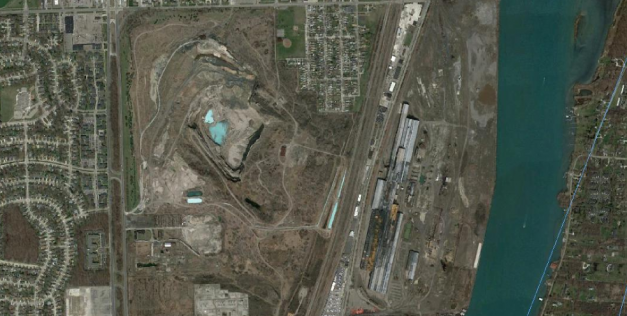
I grew up just a few hundred feet from this quarry, which would go off several times a day. Mining there involved drilling deep into solid limestone and detonating powerful explosives—like dynamite or ANFO—in carefully timed sequences. Each blast created massive shockwaves, shaking the ground, sending dust into the air, and reshaping the land in seconds. This repeated for decades, carving out the quarry we lived beside.
Facing us from the front, just a few hundred feet away, and stretching behind our backyard, was a massive black industrial structure near the Detroit River—so large it could block sunlight on certain days. It was the McLouth Steel Trenton Plant, which, fun fact, was once one of the most modern steel factories in the country when it was built.

To the left of the plant, about a mile away, was a Ford coating plant—a private industrial operation specializing in painting, coating, warehousing, and logistics for automotive, military, and industrial markets.
Trenton sat near the water, with beautiful parks and access to the river, yet these massive industrial buildings were constant, unavoidable presences—almost like scars on an otherwise peaceful landscape.
When we were younger, we would hear rumors: “I heard that factory is shutting down—they’re going to remove it.” I remember jumping with excitement, asking, “When?” impatiently. Eventually, the factory did close, and just recently it was completely removed. Now, you can even see the Gordie Howe International Bridge in the distance, nearing completion, along with parts of the Detroit skyline—the rich blue tones of the tall Renaissance Center towers.
Growing up, the quarry blasts felt like earthquakes—massive rattling, ground-shifting events that happened multiple times a day, always varying in intensity. I remember deciding I didn’t like that feeling and wanting to be outside as much as possible with my brothers and friends. It wasn’t just me—most of the neighborhood kids felt the same.
We naturally came together—forming teams, playing basketball and baseball, learning how to skateboard, exploring the wilderness, building tree houses, talking about our dreams and future—but mostly just playing, laughing, and being kids. Still, there was always this quiet awareness in the background: our parents, especially our father, working nearby in dangerous industrial conditions.
It didn’t feel like a dangerous neighborhood. It was made up of all kinds of people and backgrounds. Many were factory workers; some were entrepreneurs; some worked in tech, others in the medical field; some loved race cars and motorcycles; some formed their own small social groups; some worked in education and at our local schools.
Most kept to themselves, but they were kind, welcoming, and always willing to help if we needed anything—even though we were the only small family that spoke another language at home. They especially adored my sweet grandma.
But the adults were always worried. With an active quarry so close, a steel plant behind us, and busy train tracks running just a few streets away, there were real risks. It was strict—we had to be home the moment the streetlights came on.
During the day, it was the blasting of the quarry. At night—even at odd hours like midnight or 2 a.m.—we would hear heavy trains rushing by at high speeds, their horns blaring, waking all of us. This went on for years.
We knew that our dad worked for the big 3 Ford Motor Company, General Motors, Chrysler and had a difficult job physically, and we could smell the scent of oil when came back from work. He would have a dedicated washing machine just for his work clothes and they would pile up quickly and were washed constantly. From our senses , sight, hearing , smell , touch, feeling, we were fully immersed and surrounded by the old world and new world , the infamous industrial backbone of North America, the capital of the automobile production industry, and not just..
The Downriver industrial corridor around Trenton holds major historical significance in the United States because it was part of the integrated manufacturing system that helped transform America into a global industrial and economic power in the 20th century. Anchored by the “Big Three”—Ford Motor Company, General Motors, and Chrysler—this region connected raw materials like limestone from sites such as Sibley Quarry to steel production, energy generation, and automobile assembly, all within a concentrated geographic area along the Detroit River. This model of large-scale, vertically integrated industry not only fueled mass production and the rise of the American middle class, but also supported national infrastructure, wartime manufacturing during events like World War II, and the expansion of consumer culture, making the region a cornerstone of America’s industrial identity and long-term economic development.
The resilience, the sacrifices, the hard work, backbone of US. Steel production, held a whole nation.. Often physical jobs, many battered people, the outside shell effected but still full of depth, and yes some full of sorrow and regrets, especially of how strongly this area was hit by the 2008 economic crisis, that stopped work for the majority of the population in this region. But what I know for sure , growing up in this region is that most are good hearted people who welcomed us in their tight community from birth, and allowed us to also join them, and contribute regardless of anything, and welcomed us to contribute to a much better cause and future..
If there is any word to sum up this neighborhood, it’s hard-working, thoughtful people. It’s 2026, and many of the factories around us in Trenton have shut down. The quarry no longer functions, and the steel factory behind the house has closed as well. I’ve never seen so many fishing boats on the water in my life.
Now, the only thing standing between us and fully enjoying the water directly behind the neighborhood is a metal fence—one that could easily be taken down—but beyond it lies land that is still being tested for chemicals. Even after all these years, that land is still not considered safe or livable, and new homes cannot be built there because the contamination remains too dangerous for the human body – hopefully they clean up the mess quickly.
As mentioned, to the left of this existing factory is the Ford coating plant, and the heavy trains that once carried industrial products several times a day—and throughout the night—have now almost completely stopped, with only the occasional train passing once in a great while.
The design of the homes in the neighborhood always fascinated me. They were built in the early 1950s, during a time when the residential area near the McLouth Steel plant in Trenton expanded rapidly as part of the post–World War II housing boom. From the late 1940s through the 1960s, thousands of steelworkers needed housing, and this neighborhood emerged to support one of the region’s largest industrial workforces.
These homes were primarily modest, single-family residences—most commonly ranch-style houses, Cape Cods, and brick bungalows—designed with efficiency, affordability, and speed of construction in mind. Their architecture reflected broader national trends in suburban development, emphasizing practical layouts, usually two to three bedrooms, simple rectangular footprints, and either attached or detached garages. Durable materials like brick were commonly used, shaped by Midwestern building traditions and the economic realities of working-class families striving for stable homeownership.
Their development was deeply tied to the rise of union-backed industrial wages and federal housing policies such as FHA loans, which made homeownership more accessible. These homes represented the American ideal at the time—families living close to stable jobs, building communities, and creating a sense of independence.
At the same time, their proximity to heavy industry—along the Detroit River and near major plants—reflects a defining characteristic of the Downriver region, where residential life and industrial production were deeply intertwined. These neighborhoods came to symbolize both economic opportunity and the environmental trade-offs of America’s industrial expansion.
I often traveled and worked away from downriver as an adult (as soon as I got a car), but in recent years I would take Jefferson ave, a beautiful road that's alongside the Detroit River and it takes you directly to downtown Detroit without any turns. On the way to Detroit from our house to Downtown Detroit, you drive by Wyandotte, MI.
As you drive from Trenton toward Detroit, passing through Wyandotte means crossing through a city known not only for its industrial roots, but also for its unique role during one of America’s most notorious eras—Prohibition in the United States. While Wyandotte did develop as an important center for chemical and pharmaceutical production (with companies like BASF establishing a major presence), what it became especially famous for was its strategic location along the Detroit River—a narrow international border separating the U.S. from Canada, where alcohol remained legal. During Prohibition, this stretch of river turned into one of the busiest smuggling routes in the country, and Wyandotte was right in the middle of it. Small, fast boats—often operating at night—transported whiskey and other liquor from Canada into Michigan, supplying Detroit’s underground bars and fueling organized crime networks. Locals, fishermen, and organized groups alike participated in what became known as “rum-running,” making the Downriver area, including Wyandotte, a key gateway for illicit alcohol into the United States. This legacy gave Wyandotte a reputation tied to both industrial production and underground trade, blending blue-collar factory life with the shadow economy of the 1920s. Today, while it is known for its historic downtown and riverfront charm, Wyandotte’s identity is still shaped by this dual history—a city of industry by day, and once, a critical corridor of Prohibition-era smuggling by night. Which also famously was the location of our very first brick and mortar business called “La Perle”:).
Past Wyandotte, as you continue driving north toward Detroit, you enter Ecorse—a small, tightly packed industrial city that grew around steel mills and manufacturing plants in the early 20th century. Generations of working-class families built their lives here, relying on factory jobs tied to companies like United States Steel.

At first, the shift feels gradual—quiet streets, modest homes, and the lingering sense of a place that once thrived on steady factory life. As you move through Ecorse, you pass tightly packed, aging houses—paint peeling, porches sagging, and chain-link fences leaning slightly inward, as if worn down by decades of industry. The roads feel rougher beneath your tires, and the air grows heavier, carrying that faint metallic edge that never fully leaves this part of Downriver.
Then, almost suddenly, the horizon changes. Rising ahead is the massive presence of United States Steel’s Great Lakes Works, stretching across Zug Island and the surrounding riverfront. Even now, it dominates everything around it—but there’s a noticeable quiet compared to what it once was.

Decades ago, this landscape felt almost unreal. Towering blast furnaces belched fire, smokestacks poured thick plumes into the sky, and an orange glow pulsed day and night, as if the ground itself were alive. The entire area moved with constant energy—heat, noise, and machinery—an industrial rhythm that never stopped.
As you get closer, the scale becomes overwhelming. Steel structures stretch endlessly—pipes, conveyors, and skeletal frameworks layered over generations of expansion. The air carries the scent of iron and grit. This wasn’t just a factory—it was one of the engines that built America. For over a century, United States Steel helped shape the modern world, producing the steel that built railroads, skyscrapers, automobiles, and entire cities. At its peak, it stood as the largest corporation on earth—a symbol of American industrial dominance felt far beyond its borders.
At the same time, this stretch became one of the most intense industrial environments in the country. The operations—molten metal processing, and continuous heavy manufacturing—brought both economic power and serious consequences. The area was long associated with environmental and safety concerns, including high levels of air pollution, particulate matter, and industrial byproducts. Nearby residents reported loud metallic booms and even unexplained low-frequency vibrations, known as the “Zug hum.”
It was essential to America’s steel supply, but it was also one of the more hazardous industrial zones—where workers faced dangerous conditions, and surrounding communities lived with the long-term effects of industrial exposure.
Today, much of that intensity has slowed. Production is far more limited, parts of the facility sit quieter, and the constant fire and motion have softened into something more subdued. But the weight of what it once was still lingers. You can almost hear it—the echo of molten steel pouring, the deep clang of machinery, the long shifts that stretched into dangerous nights.
And for us, this isn’t distant history—it’s personal. My dad spent countless days here, and long, dangerous nights inside those structures. Nights where the heat was relentless, the work physically demanding, and the risks always present. Places like this weren’t just jobs—they were sacrifices. They built families, carried communities, and demanded everything in return.

Around it all, the neighborhoods remain—aged, resilient, and shaped by decades of industrial life. Homes stand stubbornly beside one of the most intense industrial zones in the country, as they always have. Residents lived with the consequences: thick air, constant mechanical noise, sudden booming sounds, and the eerie low-frequency “Zug hum” that seemed to vibrate through walls at night.
Driving past now, there’s a contrast that’s impossible to ignore. The giant that once roared with fire moves more slowly, almost like it’s catching its breath, while the homes and streets beside it carry the memory of everything it once was. This stretch—from Ecorse into the shadow of Zug Island—feels rugged, raw, and deeply American: a place where immense strength was forged in fire, and where the human cost is still quietly written into the landscape and into the lives of people, like my dad who has spent many countless days working at zug , and some very long dangerous nights.
As you continue north past Zug Island, the landscape doesn’t soften—it stretches further into a long corridor of industry that feels endless. The intensity of United States Steel may begin to fade behind you, but it gives way to something just as telling: a patchwork of still-functioning plants, aging factories, and infrastructure that has been built, rebuilt, and worn down over generations.
Moving through River Rouge and toward southwest Detroit, you pass active essential facilities—smaller steel processors, logistics yards, concrete plants, scrap metal operations, and distribution centers. Trucks move steadily in and out, rail lines cut across the road, and industrial stacks still release thin trails of smoke into the sky. It’s not the same overwhelming force as Zug at its peak, but it’s constant—working, grinding, sustaining what remains of the region’s industrial backbone.
Alongside it all, the housing tells another story. Blocks of homes sit just feet from factories and rail yards—many of them old, worn, and visibly shaped by decades of exposure to industry. You see boarded windows, patched roofs, houses that look like they’ve been holding on for years. Some are still lived in—cars in the driveway, lights on inside—while others feel abandoned, slowly giving way to time. Entire stretches feel frozen between past and present, where the decline of heavy industry left its mark but never fully erased the communities that depended on it.
Then there are the factories themselves—some still running, others long shut down. Rusted structures, broken windows, and empty lots appear between active sites, reminders of companies that once fueled this corridor but didn’t survive the economic shifts. It’s a landscape layered with history—every block showing a different stage of rise, decline, or adaptation.
As you get closer to Detroit, something new begins to cut through it all. Construction. Fresh concrete, widened roads, new overpasses rising where older infrastructure once stood. Crews, cranes, and barriers line parts of the route as the city reshapes this industrial corridor for the future. The most striking of these changes is the approach toward the new and magnificent Gordie Howe International Bridge— The Gordie Howe International Bridge cost about $6.4 billion USD, with Canada covering nearly all upfront costs (including the U.S. side), to be repaid over time through toll revenues. A massive, modern project that feels almost symbolic. Where the old factories speak to America’s industrial past, this bridge points toward what comes next: trade, connectivity, and reinvestment in a region that has seen both extremes, located near Zug island, almost overpowering it looking down on the filthy zug island.

The contrast is sharp. On one side, aging homes and decades-old factories—gritty, worn, and deeply rooted in history. On the other, brand-new roads, infrastructure, and one of the most ambitious border projects in North America rising into the skyline.
Driving through this stretch, you feel like you’re moving through time itself—past the echoes of heavy industry, through its lingering presence, and into something still being built.
Near the Gordie Howe International Bridge, just beyond the aging factories and industrial corridors, Ford Motor Company has built one of the most advanced manufacturing facilities in the country—the Ford Rouge Electric Vehicle Center. Opened in 2022, this facility is where Ford produces the all-electric F-150 Lightning, marking a major shift from traditional gas-powered vehicle production to a new era of electric mobility.
Inside, the plant operates with cutting-edge technology—highly automated assembly lines, advanced robotics, AI-assisted quality control, and digitally connected systems that monitor production in real time. Unlike older factories that focused on engines and heavy mechanical parts, this facility is designed around electric vehicle architecture, with specialized processes for battery integration, high-voltage systems, and software-driven performance. It reflects a fundamental transformation in how vehicles are built—less about raw mechanical power, and more about precision engineering, energy systems, and technology integration.
Its importance goes beyond innovation. For the Detroit and Downriver area, this facility represents economic renewal and long-term relevance. Built on the historic Rouge site—once the heart of America’s industrial strength—it brings new investment, modern jobs, and a future-focused identity to a region long defined by heavy industry and decline. Positioned near a major international crossing and trade route, it reinforces Detroit’s role not just as the birthplace of the auto industry, but as a leader in its next chapter.
Near the Gordie Howe International Bridge, just beyond the industrial corridor and across from the modern facilities of Ford Motor Company’s Ford Rouge Electric Vehicle Center, sits one of Detroit’s most historic and overlooked landmarks—Fort Wayne.
Built in the 1840s, Fort Wayne was originally constructed as a military fortification to defend Detroit and the strategic Detroit River following tensions with Britain after the War of 1812. Designed as a classic star-shaped fort, it later expanded into a full military installation with barracks, parade grounds, and support buildings. Over time, it played roles in multiple chapters of American history—serving as a mobilization and training site during the Civil War, World War I, and World War II.
What makes its presence here so striking is its contrast with everything around it. Sitting along the river, Fort Wayne’s open grounds, historic brick buildings, and quiet, preserved space feel almost frozen in time—directly beside one of the most industrialized corridors in the country. On one side, you have centuries-old military architecture and the early foundations of Detroit’s strategic importance. On the other, massive steel plants, modern electric vehicle production, and a new international bridge rising into the skyline.
This juxtaposition captures the full timeline of the region in a single glance: from 19th-century defense and early settlement, to 20th-century industrial dominance, to 21st-century reinvention. Fort Wayne stands as a reminder that long before the factories, before the steel, and before the bridge, this land was already central to America’s story—guarding a river that would go on to become one of the most important economic corridors in North America.
The design of some of these historical buildings I see in the shadow of some of the homes built in my parents neighborhood in the 1950’s.
As you drive a few more minutes and turn right onto Fort Street, you officially enter Detroit—and the shift is immediate. The industrial weight of the Downriver corridor begins to lift, and the road opens into a city that has undergone one of the most remarkable transformations in the country. Detroit, once defined by decline and labeled for years as one of America’s most dangerous cities, has spent the past 15 years rebuilding itself—block by block, investment by investment.

In the early 2000s and especially around the time of the 2013 bankruptcy, Detroit faced deep economic collapse, population loss, and high crime rates, at one point earning the reputation as the “murder capital” of the United States. But what followed has been a sustained and visible comeback. Billions of dollars have been invested into downtown and surrounding neighborhoods—led by a mix of private developers, major corporations, and public funding. Areas like Campus Martius, the Riverfront, and Midtown have been completely reimagined, with new restaurants, residential buildings, office spaces, and public parks bringing life back into the city.
Companies like Quicken Loans (now Rocket Companies) played a major role by moving thousands of employees downtown, helping anchor economic activity and attract new businesses. The Detroit Riverwalk—once underutilized—has become one of the most celebrated waterfronts in the country, drawing residents and visitors alike. New developments, including luxury apartments, renovated historic buildings, and modern commercial spaces, continue to reshape the skyline.
Equally important has been the improvement in public safety. Crime has significantly decreased from its peak levels, and while challenges still exist, Detroit today is far safer and more active than it was just a decade ago. The city has focused on community policing, investment in neighborhoods, and economic opportunity—all contributing to a gradual but meaningful shift.
What makes this moment powerful is the contrast. Just minutes after passing through some of the most intense and historically burdened industrial zones in America, you arrive in a downtown that feels alive, forward-moving, and full of momentum. Detroit’s story isn’t just one of hardship—it’s one of resilience, reinvention, and growth, proving that even after decades of decline, a city can rebuild itself into something new.
As I’m writing this, I’m sitting at the Detroit River International Wildlife Refuge in Trenton—just five minutes from where I grew up—and it’s hard not to pause and take in what this place represents. This isn’t just a park. It’s one of the only international wildlife refuges in North America, stretching along the Detroit River and connecting ecosystems between the United States and Canada. Right here in Trenton, it includes the John D. Dingell Jr. Visitor Center and the protected lands of Humbug Marsh—one of the last remaining natural wetlands along this historically heavily industrialized river.
The refuge offers miles of trails, open shoreline, a long fishing pier, and access points for kayaking, but what makes it truly special is what it protects. Humbug Marsh is a rare ecological treasure—home to migratory birds, fish spawning grounds, and native plant life that once dominated this region before industry took over. It’s one of the last places where you can see what the Detroit River used to look like before factories, shipping, and heavy development reshaped its edges.
And that’s what makes this moment feel so significant. Looking out at the water today, there are fishing boats everywhere—lined across the river, people casting lines, moving freely, enjoying something that once felt impossible. Because not long ago, the Detroit River was known for something very different. It was one of the most polluted rivers in the United States—heavily contaminated by decades of industrial discharge, oil, chemicals, and waste from steel mills, factories, and urban runoff. It was a working river, not a recreational one. Fishing wasn’t something people associated with it—it was something people avoided.
For much of the 20th century, the Detroit River symbolized industrial strength, but also environmental neglect. It played a critical role in Michigan’s economy—fueling shipping, manufacturing, and trade—but at a cost. Water quality suffered, wildlife declined, and access to the river as a natural resource was limited.
What I'm seeing today is the result of decades of restoration, policy changes, conservation efforts, and community investment. The creation of the Detroit River International Wildlife Refuge marked a turning point—protecting land, restoring habitats, and reintroducing the idea that this river could be both economically important and environmentally thriving.
And sitting here now, watching boat after boat move across the water, it makes you think—did we ever believe this was possible? That this same river, once defined by pollution and industry, would become a place where people come to fish, to kayak, to watch birds, to slow down?
It’s more than just a scenic spot—it’s proof of recovery. Proof that even places deeply shaped by industry can be restored. And for those of us who grew up just minutes away, it feels personal—like watching something once overlooked come back to life in a way we never fully expected.
The air feels different now—cleaner, lighter, evolving toward something more sustainable. And the fishing boats out on the water today say everything. They are proof that the water is cleaner, that life has returned in a way that once seemed unlikely. What used to be a river defined by pollution and industry is now a place where people gather, fish freely, and reconnect with it.
But that transformation didn’t happen in isolation. It rests on generations of labor. The older generations, and many in my own generation, spent years on assembly lines, inside steel plants, and in environments defined by extreme heat, deafening noise, and chemical exposure—places where heavy protective gear wasn’t optional, but necessary just to enter. This region was built by people who worked in some of the most physically demanding and dangerous conditions in the country.
And alongside that history is something equally powerful—the people who call this place home. Downriver Michigan has long been shaped by a deeply diverse and immigrant population. Today, in the broader Detroit region, over 20% of residents are immigrants or children of immigrants, representing communities from Eastern Europe, Latin America, and Middle East beyond. These communities didn’t just settle here—they built lives here, worked in these industries, raised families, and became part of the fabric of this region.
What’s striking now is that the recovery isn’t just environmental—it feels human. As the air improves and the water comes back to life, so do the communities connected to it. There’s a quiet resilience here—a sense that both the environment and the people are moving forward together.
But there’s still more to be done. While we’ve made real progress in improving air quality and restoring the river, I would hope to see that same level of investment continue to reach the people—especially the working-class and immigrant communities that carried this region for generations. Their contribution is foundational, often overlooked, and deeply American.
My love for the people of Downriver runs deep. And with everything this area has given—to the state, to the country, to entire industries—I hope to see that same level of care and investment come back to them, especially in their health and well-being. Because they deserve more than just recognition for what they’ve built—they deserve to live long, healthy lives in the very place they helped shape.
Because Downriver isn’t just an industrial story—it’s a human one. A story of endurance, sacrifice, diversity, and now, renewal. I would love to see further improvement in health in the resilient, historic, and often heroic population of Downriver, Michigan USA.
Anja


Comments